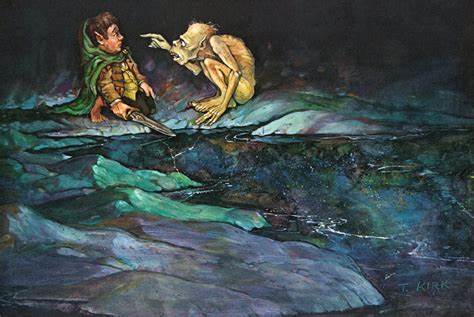
One thing that I try and insert into all my campaigns are puzzles and riddles. That is probably not a huge surprise given that I was absolutely enthralled by The Hobbit and The Lord of the Rings. I loved the Riddles in the Dark chapter and the discussion between Bilbo and Smaug. The elegance and artistry of telling a story through a competition of words is something that always has stuck with me and that I try to recreate in some ways.
There are many sites that have riddles that you can use for your campaigns. Here are a couple that I found really helpful:
100 Riddles and Their Answers – Dndspeak
Riddles in the Dark (chapter) | The One Wiki to Rule Them All | Fandom
D&D: Riddles A DM Can Use To Challenge An Experienced Party (thegamer.com)
There are many, many more. It is a tactic that I am surprised isn’t used by more Dungeon Masters. I really like to make my campaigns a balance of adventuring, combat, role-playing, and problem solving. Riddles and puzzles fall directly into the problem solving motif.
I also think puzzles and riddles are a great way to break up the monotony of a standard game of dungeon crawling, exploring, combat, and acquisition. It throws a different challenge at players that they have to shift gears to solve. The main challenge I have is finding riddles that are difficult, but not impossible. The worst thing you want is to have your players get frustrated and not be able to advance.
To manage this, I usually have a series of riddles ready to go and customize the next riddle based upon how the party has been able to answer the current riddle. My goal is to provide a challenge for the players and make them feel challenged and a sense of accomplishment. I’m not their adversary and I don’t want to stump them. At least not permanently. There is nothing wrong with the players understanding that don’t YET have the answer to the puzzle or riddle.


Leave a Reply