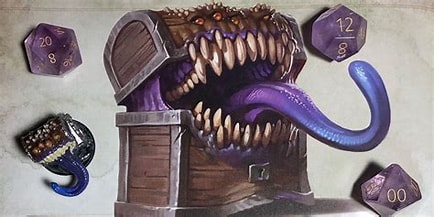
This is the first post of a recurring series of monster of the week. This series will be used to share my favourite monsters and the unique capabilities of monsters and strategies that can be used with the monsters.
Anyone that has played with me can probably attest that I love Mimics – perhaps too much. My players now approach every inanimate object with skepticism and trepidation – and right fully so. I have been known to use Mimics that take the form of tables, chairs, treasure chests, and doors. I love the surprise aspect of the Mimic and how it can turn a safe moment into a desperate battle.
There are two strategies I have used recently with Mimics that I see are not commonly used:
- Non-solitary Mimic – traditionally it seems the Mimic encounter is in an empty room that seems non-threatening. The Mimic often times is the only monster in the room or cave. Usually the Mimic is a door, chair, or treasure chest. When the adventurers approach it changes shape and attacks! But what if the Mimic is not just one Mimic, but a party of Mimics? And what if the Mimics are furniture in a room after a vicious battle with other monsters? What if the Mimics are an ambush once the party relaxes their guard?
- Delayed Mimic – traditionally the Mimic is also a large item like a chair, door, or treasure chest that attacks at it is approached. That seems to be the common attack vector, but what if the Mimic is sneaky and delays it’s attack? What if the Mimic is a sword, staff, or robe? What if the Mimic bides its time and attacks in the middle of a rest while everyone is sleeping? That is a combat that your players won’t soon forget. Even better, what if the Mimics were a clutch of weapons that all animate and attack!
Regardless, I highly recommend mixing it Mimics into your adventures. If you do it well your players may think twice about approaching objects and taking that shiny sword that seemed just a little out of place.


Leave a Reply